
I work a lot and I like my work. Actually, I pretty much love it. Most of the time. I think that about twenty years ago I could honestly call myself a workaholic. These days I’m too old for workaholism.
Over the years I’ve deliberately tamed and reined in my excessive love for work, but there was one thing I never quite mastered. Vacations.
Not that I didn’t go on them, or didn’t look forward to them. But combining longer vacations — especially the family kind — with work was always one of the biggest challenges of my year.
In the end I managed to solve it quite well. I think. Actually, we managed. Credit here also goes to my wife and our sons.
Got similar troubles and curious about a story of taming work in favour of vacations? Let’s go.
2018: The ruined vacation in Greece
Apartment 303, Hotel Diagoras, Rhodes. It’s an afternoon sometime in the summer of 2018. The rest of the family is at the sea.
I’m sitting at my computer. I haven’t slept all night. In the morning I let my wife take the boys to the beach without me. The heat on Rhodes is hellish and there are rocks everywhere. The rest of the family loves the sea. But the sea is salty and sticky. The sea is, frankly, gross. That’s not my main problem though.
I knew the feeling from other vacations, in other places. I always felt shaky there. Far more things threw me off balance than usual. Every third day brought a little crisis. Why the hell is this happening to me when I’m supposed to be resting?
Then came the insomnia. On vacation. Pretty messed up, I tell you. Why on earth can’t I sleep on vacation?
Today I know that I have to earn my sleep. With tiredness. From exercise, or from an otherwise demanding day. Effort delivered, reward follows. Sleep.
And I also know now what the problem in Greece was. I was on vacation, but I wasn’t present. I hadn’t switched my head off. Work kept running in there. Plans, clients, articles, strategies… That time it started innocently: “I won’t work, but maybe I’ll think through a few chapters of the book.”
My body was lying on Rhodes next to the sticky sea; my mind was in my little freelance business. In Greece it dawned on me that my mind was not built for things like a passive family vacation with a bit of work on the side.
2019: Tiredness in Tuscany helped me sleep
A year later we went to Tuscany. By then we had done some light preparation. Preparing Michálek for vacation.
I never even unpacked the laptop. That hadn’t happened since I went freelance. I felt a bit strange.
The urge to check email came only on day five. A light one, easy to ignore. Until then I hadn’t thought about it at all. I slept like a baby.
That vacation was packed with activities, physical ones included. Besides moving around with the family, I went running there. I was tired, occupied, and unable to think about work.
It hit me that when work has a certain intensity — and it doesn’t matter whether it’s creative intensity or managerial load — it has to be replaced by a different intensity. A physical one, for instance.
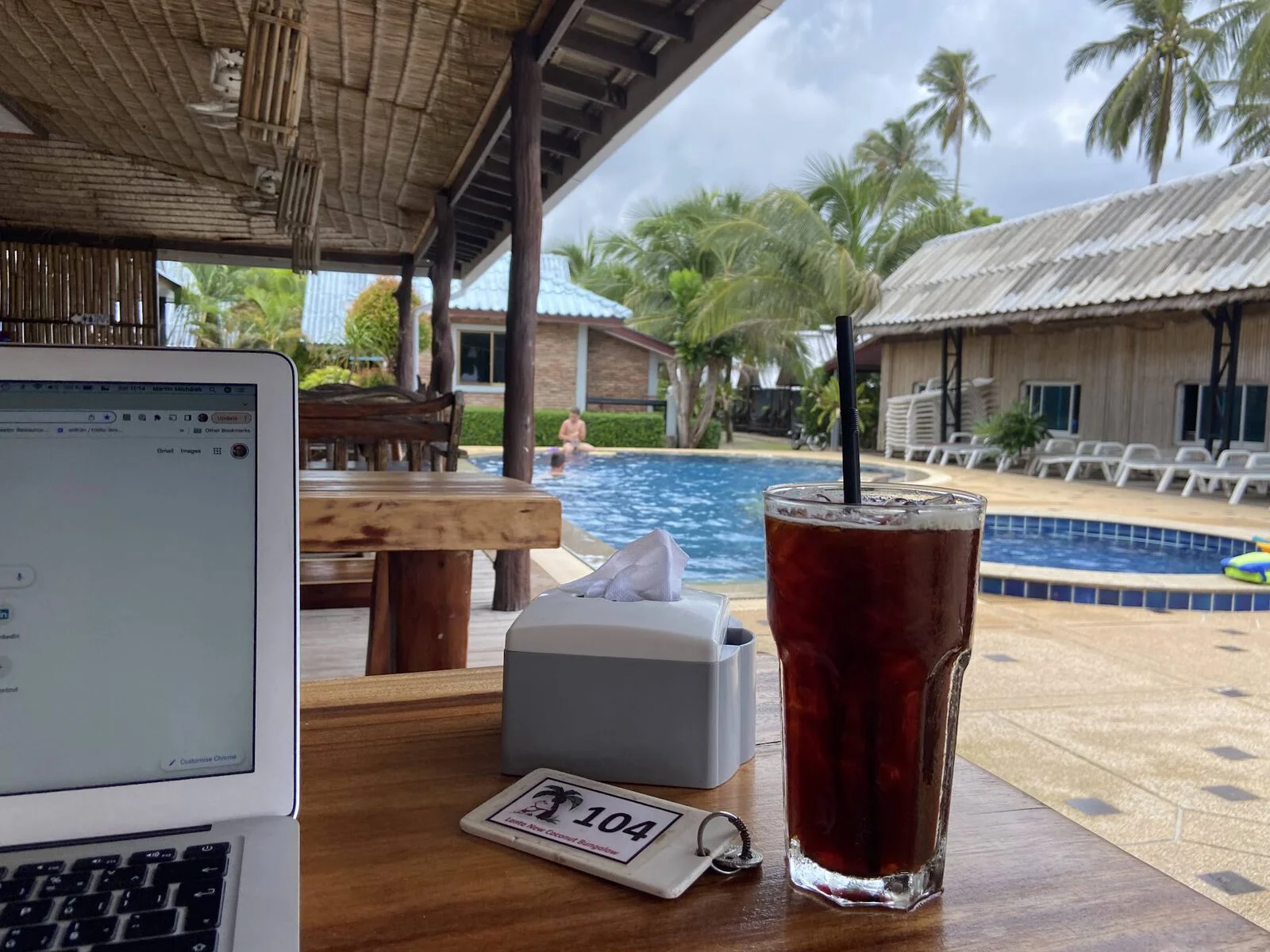
Working from a small resort in Thailand? Heaven! It never worked for me.
2023: Adventurous Thailand, where work suddenly stopped existing
The family trip to Thailand, on our own, happened in 2023. By then we had a slowly growing company. But it was the first vacation where I planned the whole work side of it systematically. Sorry — we planned.
Two and a half weeks. Five places. No itinerary, just accommodation booked in Bangkok to acclimatise. Every day we figured out where to sleep, where to hide from the heat, where to eat, how to keep the boys entertained, and how I’d survive driving in that terrifying traffic.
Work stopped existing. It got pushed out by a new, healthily stressful situation.
Pushed out. That was the key.
I used to think the problem was me. That I was a workaholic with no willpower and no interest in his family.
Thailand proved once and for all that the problem is in how the vacation is set up. A passive vacation switches on the creative part of my brain. And that part wants to work. Not because I’m a bad person. Simply out of boredom.
Active travel occupies the head differently. I found out I don’t even have to exhaust myself physically — though that bit is interesting to nobody but me. It’s enough to skip the vacation planning and get myself, and the whole family, into mild stress. You’d be surprised, but it suits all of us. It bonds us, and we have a ton of family stories.
Oh, and in 2023 I also learned something about delegation and the benefits of teamwork. Our people at PageSpeed.ONE handled the whole thing without me. We have pretty good processes, clear team roles, and a system for passing on skills. And our people are great.
I came back from Thailand still a little rattled by all that healthy stress. But the very next day I was back up to speed. I threw myself into work with enthusiasm.
Why go on vacation at all?
Sometimes I hear that people with my level of love for work simply don’t take vacations. I used to try that, but it doesn’t work for me. I need vacations. (And some people need an even longer break — a sabbatical. But that’s a story for another day.)
It’s a bit of a paradox, but when I don’t work for a few weeks, it helps me at work.
The key is the change of context. You all know this. At home or at work, the same things keep grinding through our heads. Prague, colleagues, news, social media… On the road, we usually manage to switch most of it off.
The original agenda in our heads should be replaced by as different a context as possible. Far more room for family, for example. Route planning. Taking and editing photos. Evening notes on what we experienced. Or chatty taxi drivers — I love those.
From that distance come thoughts I would never produce at my desk in Prague. In Thailand, for example, I realised how much I had started missing creative work. I began writing more again. I’ve been managing my time around it ever since. It helped.
Rest gives you one essential thing: energy. From well-designed rest I come back with energy and motivation I didn’t have before leaving.
I’m no exception. Research describes it.
The brain needs roughly three days to switch out of work mode. The theory is called Attention Restoration Theory (the Kaplans). Creative thinking only returns after a full disconnect. A long weekend won’t cut it.
One more finding, a less pleasant one. The effect of a vacation wears off roughly two weeks after your return (The Cut has a nice summary of Jessica de Bloom’s research). A bit depressing? Never mind — the memories stay, and nobody can take the reshuffled head away from you.
Sounds nice? Now, how to put it into practice
So much for my journey to vacations that work. For me, for the family, and for the company too. Now let me offer a few techniques I’ve adopted over the years.
Maybe you’ll use them. Or you see it differently and you’ll write to me.
Disconnect. For real.
Half the people who say they’re offline aren’t. Maybe they don’t bring a computer, but there’s still a phone in their pocket, blinking every few minutes. That’s not disconnecting.
Before every vacation I have this cleansing ritual. Sounds esoteric, but really I just delete things:
- The computer comes along for emergencies only. I mostly use it just for booking tickets. Work stuff I can ignore by now.
- Slack, as the symbol of acute work, goes off the phone completely.
- Social media, as a source of news from elsewhere, gets deleted entirely, because time locks and app limits don’t work on me.
The only exceptions are Gmail and Instagram, and even those I keep on a short leash.
I post Instagram stories for family and friends, which is fine. As a consumption channel, though, it’s treacherous. I want a break from politics and it shoves politics into my feed anyway. So I unfollow those sources and gradually re-add them after the vacation. The trouble with Instagram is that my older son uses it too, and even on vacation he occasionally runs up with the latest scandal of some Czech politician. Good grief, the last thing I want on vacation is dealing with those characters! So the next step is clearly parenting.
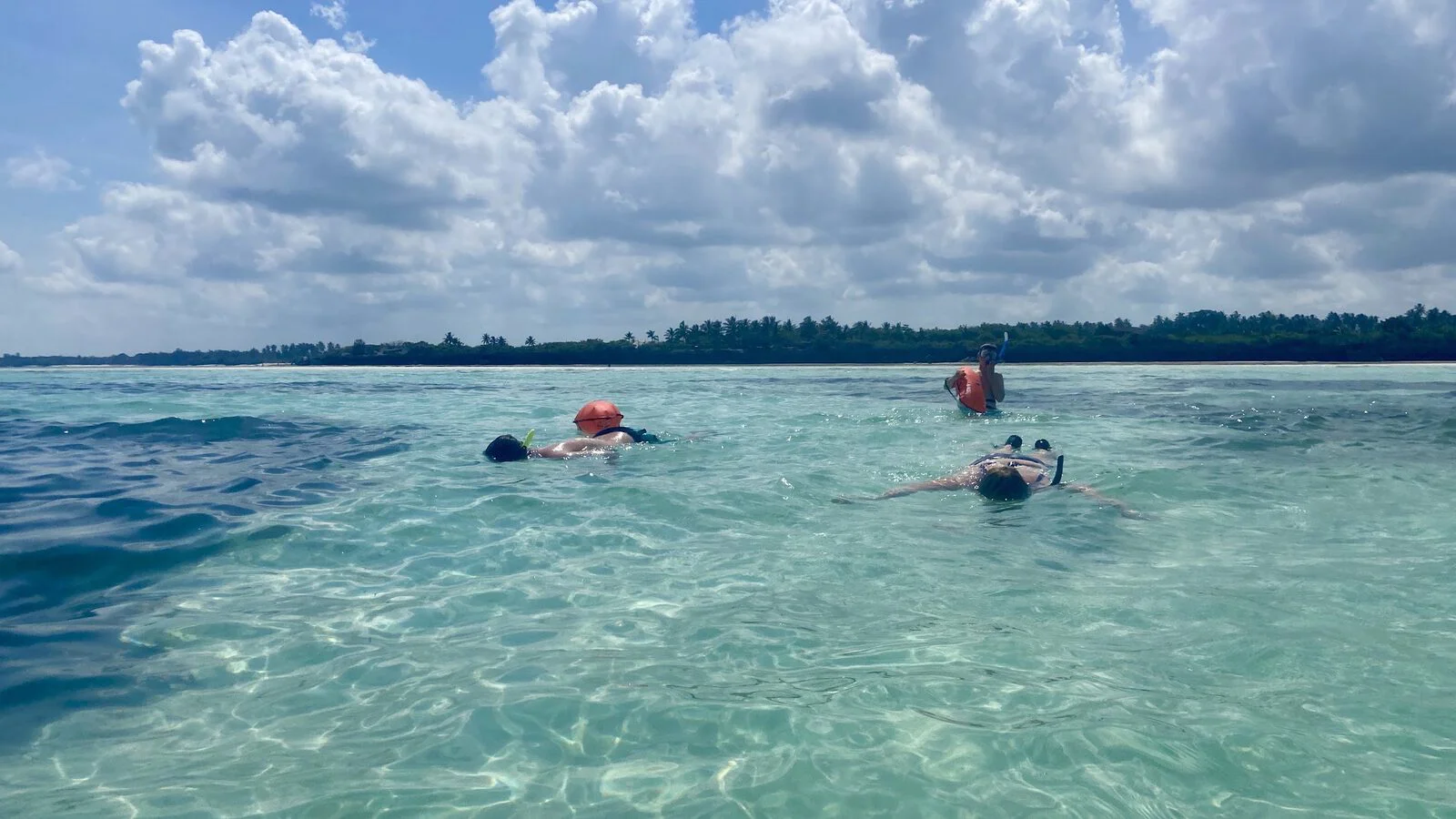
Searching for dad's laptop. Kidding. Nobody gives it a single thought. Not even dad.
I look into Gmail once a week. I delete the irrelevant, archive the rest, postpone a few things, and if I’m blocking something, I hand it over to colleagues so it doesn’t stall. Occasionally I reply, just to unblock things. This year that applied to exactly one email. The big advantage: no giant pile of email waits for me after the return. I already pruned most of it during the vacation. (In regular operation, Inbox Zero keeps things under control.)
But this only works if no monsters, disasters, or other emotional traps are waiting in your inbox. Luckily that doesn’t happen to me. The important part: for most of what I manage, someone else is responsible.
Delegate, if you have someone to delegate to
I used to think delegation meant handing out tasks before leaving. It doesn’t. It means building a team that doesn’t need me. That’s the difference between “I’m leaving, but I’ll be reachable” and “I’m leaving and there’s nothing for me to handle.”
At PageSpeed.ONE we have clear roles, reasonably functional processes, and a decent system for passing on knowledge. When I was in Thailand, the company kept running without me — that’s where it clicked. And exactly that awareness, knowing things will run without you, is the precondition for truly disconnecting. Without it, your head stays at work no matter where in the world you are.
I pick dates when clients switch off too
Resting is hardest when you know work is piling up in the meantime. That’s why it makes sense to pick a time when your surroundings slow down as well. July, August, December, January. In those months most clients are dormant too, and nobody expects an answer within the hour.
It’s not just about peace of mind during the trip. It’s practical. You come back to a smaller mess, because less accumulates while you’re gone.
Fade in before the vacation, fade out after it
Most people speed up before a vacation. They take on tasks, stay at work longer, want to “finish everything”.
The result? We leave wrung out, and we spend the first three days of the vacation — and the first three days after it — just recovering. I do it differently. Mentally, I extend the vacation by a few days on both ends.
Fade-in means dialling work down before departure, not up. My last days before a trip are my calmest, not my most hectic. I finish everything genuinely important, but I don’t invent anything extra. It’s related to the art of saying no — mostly to myself and my own “I’ll just finish this one more thing” ideas.
Fade-out is the same thing after the return. The first day home is officially a workday, but I don’t work yet. I unpack, sort photos, go through my calendar, tune back in. Only on day two do I report to colleagues on Slack at full volume. That one buffer day between travel and work saves me a week of grumpiness.
I deal with things as they come
Related to the slow ramp-up after a vacation is the continuous inbox pruning I described above.
The worst thing you can do is save everything for the return. When you come back to five hundred emails, three hundred photos, and half-written accommodation reviews, your rest evaporates on the spot.
What goes for Gmail also goes for the vacation agenda itself — photos, reviews, journal notes. I do them during the vacation. Piece by piece, not in one big batch afterwards.
The return is then soft, and when the work agenda spins up again, I’m not dragging along the frustration of never finishing the vacation photos.
And you?
A summary for the impatient workaholics who skipped straight to the end:
Working on vacation doesn’t work for me. Passively dropping my body onto a beach doesn’t work for me.
What works is chaos, and physical — or other — tiredness. What works is tuning the whole family to one shared thing. And none of it happens without a good system for the vacation and a good system at work.
Are you also the type who opens work email “just for a minute” on vacation? No judgement here. Different things work for different people, and I’d love to read your stories.